

When rain falls on your Cincinnati-area home, your gutters collect thousands of gallons of roof runoff throughout the year. Your downspouts have one important job: move that water away from your home and toward a safe place where it can drain.
But simply attaching a downspout extension isn’t always enough.
If water continues to pool near your foundation, wash away mulch, create muddy areas, or flow toward your house, the problem may be more than just a short downspout.
In this guide, we’ll explain how far downspout water should travel, where it should discharge, what warning signs to look for, and when a larger drainage solution may be necessary.

How Far Should a Downspout Extend From Your Foundation?
A common starting point is to discharge downspout water at least 4 to 6 feet away from the foundation. However, the ideal distance depends on the property’s grading, soil, landscaping, available space, and where the water can safely drain.
The goal isn’t simply to make the extension longer.
The goal is to make sure water has a safe path away from your home.
For example, extending a downspout six feet may work perfectly on a property that slopes away from the house. On another property, six feet may still leave water sitting next to the foundation because the yard is flat or slopes back toward the home.
Before deciding where to discharge the water, look at the entire path the water will take.
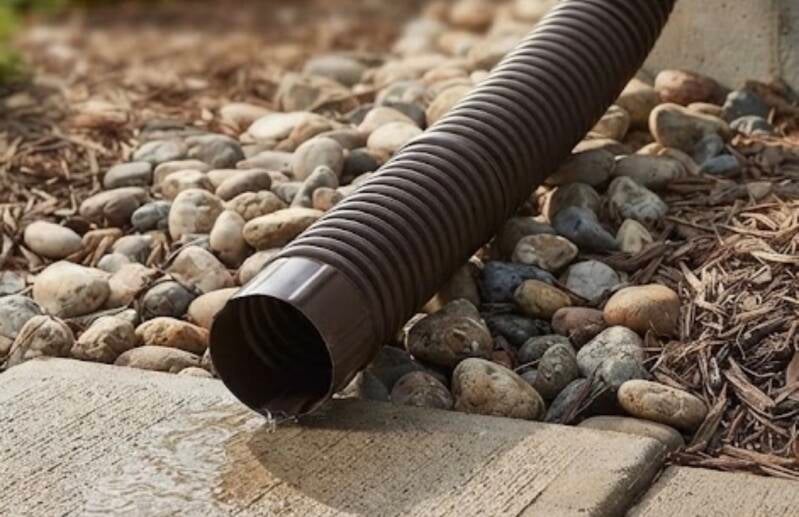
Where Should Downspout Water Go?
The best discharge location is an area where water can move away from the home without creating another drainage problem.
Ideally, downspout water should not discharge directly against the foundation, toward a basement entrance, across a walkway, or into an area where it repeatedly pools.
Look at the slope of your property.
If the ground naturally slopes away from your home, an above-ground downspout extension may be all you need.
If the yard is flat, slopes toward the house, or consistently holds water, a more involved drainage solution may be necessary.
Watch for these warning signs:
- Water pooling around the foundation
- Muddy or constantly wet areas below a downspout
- Mulch or soil washing away
- Water flowing toward a basement entrance
- Water crossing a sidewalk or driveway
- Downspout extensions repeatedly getting moved or damaged
- Standing water near a property line
- Erosion developing below the downspout
- Water collecting in the same area after every significant rainfall
These signs indicate that the problem may not simply be the length of the downspout extension.
Why You Don’t Want Water Sitting Next to Your House
When a downspout discharges directly beside your home, a large amount of roof runoff can saturate the soil around the foundation.
Depending on the site’s grading and soil conditions, this can contribute to:
- Foundation-area moisture
- Soil erosion
- Muddy areas around the home
- Landscape damage
- Basement or crawl-space moisture concerns
- Water collecting against patios, walkways, or other structures
The solution isn’t necessarily to install the longest extension possible.
Instead, you want to control where the water goes after it leaves the downspout.

Cincinnati Soil and Drainage Conditions Matter
Properties throughout Cincinnati and Greater Cincinnati can have very different drainage conditions.
Some homes have naturally sloped yards that allow water to move away from the foundation. Others have flatter areas where runoff can collect.
Clay-rich soils can also affect how quickly water moves through the ground.
Older properties may have additional drainage challenges caused by settling, landscaping changes, additions, patios, driveways, or previous construction.
That’s why there isn’t one downspout solution that works for every property.
The important question isn’t simply:
“How long should my downspout extension be?”
It’s:
“Where is this water going after it leaves my downspout?”
Above-Ground Downspout Extensions
For many homes, an above-ground extension is the simplest solution.
These extensions attach to the bottom of the downspout and direct water farther away from the foundation.
They can be a practical choice when:
- The property has enough space
- The yard slopes away from the house
- Water can safely discharge onto the lawn
- The extension won’t create a trip hazard
- The discharge won’t cause erosion or pooling
The extension should also be positioned so it doesn’t create a new problem for sidewalks, driveways, landscaping, or neighboring properties.
Underground Downspout Drainage
Sometimes an above-ground extension isn’t practical.
Homeowners may not want a long extension sitting across their lawn, or the property’s layout may not provide a good place for water to discharge.
An underground drainage line can carry downspout water away from the home to an appropriate discharge location.
Depending on the property, the system may discharge at a suitable daylight outlet or another properly designed drainage point.
Underground drainage can be particularly useful when you need to move water a significant distance while keeping the lawn and landscaping clear.
However, the system needs to be designed around the property’s slope, soil conditions, available space, and intended discharge location.
When Is a Downspout Extension Not Enough?
A downspout extension can solve a simple discharge problem, but it isn’t the right solution for every property.
If water continues to pool after installing an extension, the problem may involve the property’s:
- Grading
- Soil drainage
- Surface runoff
- Downspout layout
- Landscape design
- Existing drainage system
In those situations, options may include regrading, underground drainage, a French drain, or another drainage solution designed around the property’s specific conditions.
The goal isn’t simply to move water a few feet away from the downspout.
The goal is to give that water a safe and effective path away from the home.
When Might a French Drain Be Appropriate?
A French drain can be useful when the drainage problem involves water collecting across a larger area of the yard rather than simply water coming from one downspout.
For example, you may have:
- A consistently soggy section of lawn
- Standing water after rainfall
- Surface water moving toward the house
- Water collecting at the bottom of a slope
- Poor drainage in a low area of the yard
A French drain uses a drainage trench and perforated pipe to help collect and redirect water through the property.
However, a French drain isn’t automatically the answer to every downspout problem.
The appropriate drainage solution depends on where the water originates, where it is collecting, and where it can safely be discharged.
For properties with persistent drainage issues, professional evaluation can help determine whether a French drain, grading, underground drainage, or another approach makes sense.
Don’t Forget Your Gutters
Your downspouts can only move the water your gutters successfully collect.
If your gutters are clogged with leaves, pine needles, shingle grit, or other debris, water may overflow before it ever reaches the downspout.
That’s why fall is an especially good time to inspect your entire gutter and downspout system.
Check for:
- Clogged gutters
- Blocked downspouts
- Loose downspout connections
- Missing or damaged extensions
- Water stains below gutters
- Erosion beneath downspouts
- Water pooling around the foundation
Cleaning the gutters and checking the downspouts together can help you identify drainage problems before winter weather arrives.
Cincinnati’s Fall Weather Makes Drainage Maintenance Important
Fall brings plenty of leaves and changing weather to Greater Cincinnati.
Heavy rainfall can put your gutter and downspout system to work, while falling leaves can quickly clog gutters and downspout openings.
Before winter arrives, take a few minutes to walk around your property during or shortly after a good rainfall.
Look at where water is coming off your roof.
Then follow it.
Where does it go?
If water ends up beside your foundation or creates a recurring muddy area, that’s a sign that your current drainage setup may need attention.
What About Winter?
Getting your drainage system working properly before winter can help prevent recurring problems when temperatures begin to fluctuate.
Water that repeatedly collects in poorly drained areas can contribute to erosion, muddy landscaping, and other property-maintenance issues.
Before freezing temperatures become routine, make sure:
- Your gutters are clear.
- Your downspouts are flowing freely.
- Your extensions are securely connected.
- Water is being directed away from the foundation.
- Extensions aren’t discharging onto walkways where they can create hazards.
- Areas of recurring standing water have been identified.
A few minutes of inspection can reveal problems that are much easier to address before they become larger drainage issues.
Downspout Drainage Problems in Greater Cincinnati
Every property is different.
A solution that works for one Cincinnati home may not work for another home in Mason, Fairfield, West Chester, Sharonville, or elsewhere in the Greater Cincinnati area.
The property’s grade, soil, landscaping, roof drainage, and available discharge areas all matter.
That’s why we look at the whole drainage path, rather than simply recommending a longer extension.
Whether the issue is a clogged gutter, poorly positioned downspout, grading problem, standing water, or larger drainage concern, identifying where the water is going is the first step toward finding the right solution.
Need Help Getting Downspout Water Away From Your Home?
If your downspouts discharge next to your foundation, create muddy areas, or leave water pooling in your yard, Nienaber And Sons Lawn Care can help identify a practical drainage solution.
We provide drainage solutions, French drain installation, grading, gutter cleaning, landscaping, and property maintenance throughout Cincinnati and Greater Cincinnati, including Hamilton, Butler, and Warren Counties.
If you’re dealing with standing water, poor drainage, or a downspout that doesn’t have a good place to discharge, don’t just keep adding extensions. In some situations, a French drain or another drainage solution may be more appropriate.
Learn more about French drain installation in Cincinnati →
Let’s find a better path for the water.
Get your free estimate today.
Add comment
Comments